
• Packaging information,Package Power Dissipation
  • Discontinued Products/End of Life Plan

HOME > FAQ

FAQ

FAQ

What is a big difference between XC6602 and other high speed regulators?
Most high speed regulators use a Pch MOSFET as the transistor, which tends to have a large on-resistance for a low VIN and does not allow the VIN below the minimum operating voltage of the IC. XC6602 adopts an Nch MOSFET as the driver transistor to realize the low-input voltage operation and ultralow on-resistance.
What is the more efficient usage of XC6602?
It can more efficiently output a large current with a lower input-output dropout voltage to step down the input voltage by a DC/DC converter and branch the output to use of XC6602 as the core power source of the LSI, than to directly introduce the voltage from a high speed regulator. For example, if you want to get 1.5V from 3.6V for the core power source of the LSI, you can efficiently output a large current by stepping it down to 1.8V at first by the DC/DC converter with high efficiency and branching the 1.8V by use of the XC6602 series. It is about 35% more efficient than directly introducing the 1.5V from a high speed regulator.
XC9235/36/37 is used for XCL205/06/07. Does this integration change the characteristics?
No.
Why is the standby current indicated for XC6215 but not for XC6218?
The standby current is the small current that flows through the IC in the standby mode. XC6218 does not have the CE function, but XC6215 does. Products with the CE function have the standby mode and thus the standby current is indicated. The standby mode of XC6215 means the state where the IC has been turned off by the CE pin.
What does the standby mode mean in the case of the multi channel IC?
It means the state where the entire IC has been turned off. For Torex products, it means that the pin voltages of EN1 and EN2 are both 0V.
How does the GO function of DC/DC converters work? Does it work just like a regulator?
Torex regard the PWM/PFM automatic switch control function as Green Operation (GO) in the case of DC/DC. The GO function is defined as the switching operation between the PFM mode for a small output current and the PWM mode for a large output current. The PFM control method controls the output current by increasing and decreasing the fall time according to the output current while keeping a pulse width. The PWM control method controls the output current by adjusting the pulse width of the rise time, which keeps the rise/fall time interval constant and increases the efficiency at a heavy load. By switching between the PFM control for a small output current and the PWM control for a large output current, the quiescent current can be controlled for both of heavy and light loads.
What is the difference between the converter and the controller in the case of DC/DC?
Torex refer to an IC with a built-in driver transistor as a DC/DC converter and an IC with an external transistor is used controlled by the DC/DC as a DC/DC controller. A DC/DC converter without an external transistor in a circuit, the mounting area is reduced with less external items. However, the power dissipation should be taken into consideration because the driver transistor becomes a heat source. DC/DC controller is used, a transistor can be selected suited for the power circuit specification, but the circuit may be larger.
How does the current limiting function of DC/DC converters work?
It limits the current flowing through the Nch MOS transistor connected to the Lx pin, combining the low current limit and the next pulse duty-cycle limit. ①When the driver current exceeds a certain value, the low current limiting function is activated to turn off the pulse output from the Lx pin at any timing. ②The next pulse duty-cycle limit controls the next pulse duty-cycle to keep it smaller than the previous one.
What does the integration protection work?
When the MAX DUTY state continues for over a certain period, this function holds the output Pch driver transistor in the off state by latching the EXT/output to H. The latched state is not the shutdown. The pulse output is stopped, but the internal circuit is operating. This is an effective protection circuit for a large input-output voltage difference.
How does the short circuit protection (latch type) work in DC/DC converter?
When the FB voltage is equal to or less a certain value, this protection circuit is activated to protect the IC by turning off the driver transistor.
What is the soft-start function?
The function to soften the rise to prevent the inrush current.
Why is the DC/DC converter more effective than the voltage regulator?
In voltage regulators, the Pch MOSFET acts as a variable resistance, and the power loss can be calculated by the multiplication of the flowing current with the input-output differential voltage. In DC/DC converters, the power loss is reduced by the switching operation to gain a high efficiency with the help of inductor energy storage. Since DC/DC converters are composed of several functional elements, it is important to reduce each element resistance for a higher efficiency.
What is the ramp circuit?
The circuit that defines the switching frequency. An individually generated clock is used to generate the ramp wave necessary for the PWM operation, and each circuit is internally synchronized.
What is the synchronous rectification?
For the step down DC/DC, MOSFET is used as a low side switch, instead of the schottky diode. In the synchronous rectification, the controller IC turns on MOSFET at the right time. Because MOSFET has the smaller on-resistance than the schottky, it can realize higher efficiency than the diode under the condition of low voltage and large current. It can also reduce the mounting area than using an external schottky.
What are the load-transient response characteristics?
It indicates how much the output voltage varies and how long the fluctuation takes to converge when the output current changes steeply. The load-transient response characteristics are affected by the IC characteristics, output current conditions, and CL capacitor. The high speed regulator has a better load-transient response but a larger supply current. A large CL capacitor has a large charge capability. It can prevent the drop of the output voltage but takes long time to recover the set output voltage after an IC response. If a low speed regulator with bad load transient response is selected, the output voltage may fluctuate beyond the range of the LSI operating voltage, witch resulting in malfunction. Care should be taken for selecting a regulator IC and CL capacitor.
What is the line-transient response?
When the input voltage is changed steeply, the output voltage varies. This is the index to indicate. How the output voltage quickly recover.
How does the CL discharge function work?
The function rapidly releases the charge remained in the CL capacitor to make the VOUT pin voltage zero. The VOUT pin voltage does not reach zero immediately after being turned off by the CE function due to the charge remained in the connected CL capacitor. While the charge in the CL capacitor is gradually reaching zero, the LSI continues operating and does not work with the CE pin signal, which may cause a malfunction. This is why the discharge is required when turning off the CE pin. A larger capacitance of the capacitor needs longer time to be discharged.
What is the impedance?
This is the ratio of voltage to current of the AC circuit and indicates the difficulty of the current flow. The unit is Ω. It extends the concept of the electric resistance in the Ohm's law for DC to AC.
What does the watchdog timer work?
This timer function is continuously monitoring to check whether the microcomputer is normally operating or not and give notice of any abnormal operation.
What is the error amplifier?
The circuit that is continuously comparing the output voltage with the reference voltage to amplify the difference to control the signal to the controller transistor.
What is the open drain?
The output type of the CMOS logic IC that has the open drain output, which means that the drain of the output transistor is directly introduced to a pin without any internal connection.
What is the open loop gain?
The gain of the circuit without feedback, represented by the ratio of output voltage to input voltage in dB.
What does Active High mean?
This means a function operating at HIGH. The opposite is Active Low, which means a function operating at LOW.
What is the meaning of the VDD?
The voltage applied to the power-supply pin of the IC to drive it.
What is the VIN?
The voltage that is input to the circuit.
What is the threshold?
The value that is specified for a specific function to operate. The function is turned on and off by inputting voltage which is higher and lower than this value respectively. For CMOS circuits, an input value near the threshold may cause a misjudgment between H and L. To avoid such a case, many circuits employ a certain range of threshold, and consider the value which is equal to the upper limit or more as H and the value which is equal to the lower limit or less as L.
What is the HIGH voltage?
A voltage that is higher than the threshold.
What is the LOW voltage?
A voltage that is lower than the threshold.
What does USP stand for?
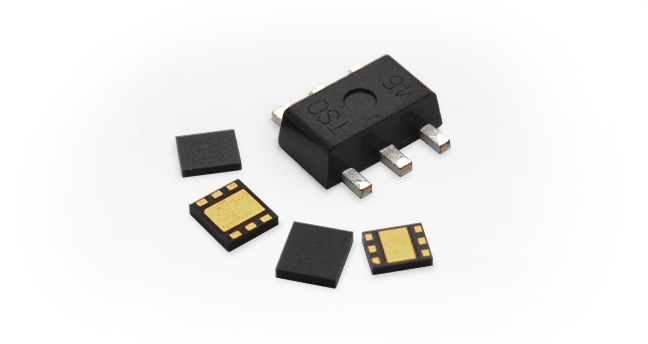
Ultra Small Package. It is a Torex's special micro package without projecting pins.
What is the Ohm's law?
V=I×R
What does CL mean?
Load capacitor. Other companies often refer to it as COUT.
What is the quiescent current?
The current, required for the IC operation, that flows through the IC with no load. For a mobile phone, remote control, and other applications of which the waiting time is long, an IC with a small quiescent current should be used to reduce the draining of the battery. An IC with a high speed transient response tends to have a large quiescent current.
What is the standby current?
The current that flows through the IC in the standby mode. The standby mode means the state where the IC has been turned off by the CE function.
What is the EXT pin?
The pin to which the switching pulse is output in DC/DC. It is connected to the gate of the MOS. The on time of this pulse defines duty cycle.
What does the FB product mean?
An IC for which any output voltage can be set by the reference voltage of the FB pins and the external dividing resistor. The output voltage is determined by the RFB1 and RFB2 values, using the following formula: VOUT = Vref × (RFB1 + RFB2)/RFB2
What type of product does the VOUT product mean?
The VOUT product means the one whose output voltage is preset and fixed by internal diverting resistors.
What is the load regulation?
It indicates how much the output voltage or output current varies when the load changes. This index represents how much the output voltage drops as the output current is increased.
What is the pulse skip (blocking oscillation)?
A phenomenon of the switching pulse skipping with a small input-output voltage difference, or at a step down/heavy load or step up/light load. Skipping pulses helps to keep the output voltage constant. It may be solved by adjusting the L inductance or the CL capacitance.
What is the switching frequency?
The switching cycle of an IC. It depends on the parasitic capacitance or inductance of the board layout or peripheral parts. It synchronizes with the ripple voltage.
How does UVLO (under voltage lockout) work?
This circuit forcibly turns off the driver transistor when VIN drops below the UVLO voltage. If the input voltage recovers to the value which is equal to the specified value or more, UVLO will be released to resume the switching operation. It is resumed by the soft-start function. The paused state by UVLO is not the shutdown. The pulse output is stopped, but the internal circuit is operating.
What does the rated voltage value mean?
It means the guaranteed service limit value.
What is the output impedance?
The resistance value in the output part of the AC signal electric circuit. Because the same resistor has different resistance values in AC and DC, it is called "impedance" for AC in distinction from the "resistance value" for DC.
What does the gain mean?
To amplify a signal by an amplifier or its amplification factor. It is represented by the ratio of the input and output signals in dB.
What is the virtual short?
A virtually shorted state of the positive and negative input pins of an Op Amp where their voltage difference is almost zero. Usually in Op Amps, the output voltages of the positive and negative input pins are almost matched (voltage difference is zero) at any time by a negative feedback effect. This state is called "virtual short" since it looks as if the circuit is shorted. It is not actually shorted, and there is no current flowing between the two pins.
back to top